
January 1, 2026
I’ve started thinking about my decisions differently as I’ve gotten older.
Not in a dramatic, end-of-life way. More practically. More plainly.
I’ve come to realize that future me needs a helping hand.
I no longer assume I can just pick up on a job where I left off without missing a beat. Memory fades. Energy changes. Context evaporates. This becomes especially obvious when I’m coding. I’ll open an old piece of code and feel a genuine sense of relief when I see that past me took the time to comment it properly - not just what the code does, but why it exists at all. Comments that don’t assume I’ll instantly remember the original intent feel like a small act of consideration.
At times like this, I catch myself wanting to say thank you to past me.
Thank you for the foresight.
Thank you for treating me with a bit of respect.
And it makes me want to return the favor - to do the same for future me.
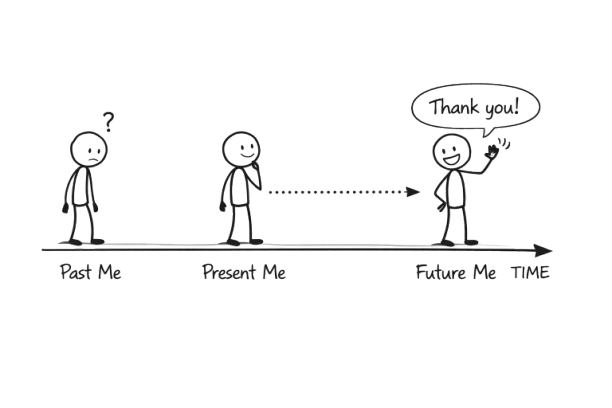
Once you notice it in code, you start seeing it everywhere.
How I spend my time.
What I eat.
Whether I put my tools back where I’ll actually find them next time.
Each of these is a modest decision about whether I’m going to make life easier or harder for the person I’ll become. Some days I do better than others.
And sometimes, I run headlong into places where past me clearly didn’t do as good a job as he could have.
Last year, I had a heart attack. A mild one, thankfully - but still enough to bring a flood of complicated emotions. Fear, of course. Gratitude. But also guilt. And disappointment. A recognition that past me made choices that stacked the deck in the wrong direction.
I don’t spend much time beating him up for it. That doesn’t help. But I also don’t tell myself a comforting story that he was doing “the best he could.” He wasn’t. And if I’m being honest, present me isn’t either.
I don’t think “do your best” is a particularly realistic standard to hold continuously. It’s fine as an aspiration in moments - a sprint, not a lifestyle. I’m too much of a realist to expect sustained, perfect effort from a human being, especially one with habits, blind spots, and a talent for rationalization.
What is realistic is striving to do a little better, more often.
To notice when today’s convenience becomes tomorrow’s problem. To recognize when I’m borrowing against my own future - or against someone else’s - and to pause long enough to make that borrowing intentional.
Seen this way, most days are full of small chances to set the stage - not just for who I’ll be next year, but for who I’ll be next week, or even tomorrow morning.
And if I zoom out just a bit further, I realize something else.
At some point, future me won’t even be there as the recipient of today’s choices.
There will still be future you. Future people I haven’t met yet. Maybe even people who haven’t been born yet. I can still tend the path for them - leave things a little clearer, a little safer, a little easier to pick up than I found them. That feels like a form of regard. Maybe even care.
That feels like a good lens to view today through.
I’ve heard it said that you shouldn’t live in the past or the future, but in the now. I think that’s mostly right. There’s real danger in becoming so future-conscious that we forget to experience and appreciate the present moment we’re actually standing in.
This isn’t about living for the future.
It’s about living with awareness of it.
A balance between presence and preparation. Between enjoying today and leaving tomorrow with fewer obstacles than it might otherwise have.
Perhaps the most practical form of kindness is making it easier for someone else to continue the work. Sometimes that someone else is future me, opening a file, picking up a habit, or dealing with the consequences of a choice I’m making today. Sometimes it’s someone I’ll never know at all.
“What do we live for, if it is not to make life less difficult for each other?”
- George Eliot